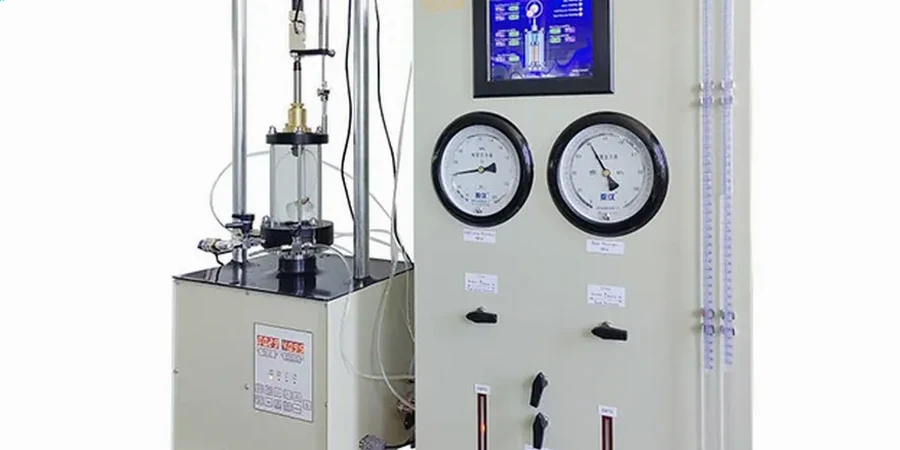
The National Building Code of Canada (NBCC) demands a clear understanding of soil shear strength before a shovel hits the ground on any major Kitchener project. The triaxial test delivers that data. Our lab runs consolidated-undrained (CU) and consolidated-drained (CD) triaxial tests on Shelby tube samples pulled from sites across the Grand River valley and its tributary moraines. Kitchener sits on a complex stratigraphy of Port Stanley Till and Waterloo Moraine deposits; assuming drained parameters from a simple direct shear box can misrepresent how these silty tills behave under load. We pair the triaxial cell with precise back-pressure saturation to measure effective cohesion and friction angle, giving structural engineers the parameters they need for deep excavations in the downtown core or slope stability analysis along the riverbank escarpments.
Effective cohesion and friction angle from the triaxial cell are the difference between a retaining wall that holds and one that rotates — we've seen both outcomes in Kitchener till.
Scope of work
Site-specific factors
The Waterloo Moraine isn't a uniform blanket of till. A 2019 geotechnical investigation near the Kitchener GO corridor revealed a 15-meter-thick sequence of interbedded clayey silt and sand, with a water table fluctuating only 2.5 meters below grade. Relying on total stress analysis in that environment is a gamble. The triaxial test isolates pore pressure behavior: we measure B-values above 0.95 before shearing and track excess pore pressure through the entire failure process. If a contractor ignores undrained strength and excavates a 10-meter basement adjacent to an existing structure, the basal heave potential is real. Kitchener's downtown geology demands effective stress parameters from a consolidated-undrained triaxial test, not an estimate from SPT blow counts. A single slope failure in 2021 near Victoria Street cost the developer six months of delays, a direct result of using total stress parameters where drained conditions governed.
Watch the video
Reference standards
ASTM D4767-11 (Consolidated-Undrained Triaxial Compression Test), ASTM D7181-20 (Consolidated-Drained Triaxial Compression Test), NBCC 2020 (National Building Code of Canada — geotechnical seismic provisions), CSA A23.3-19 (Design of Concrete Structures — foundation references), OPSS 501 (Ontario Provincial Standard Specification — compaction acceptance)
Linked services
Consolidated-Undrained (CU) Triaxial Test
The standard package for short-term loading scenarios in Kitchener's silty clay till. We run three specimens at different confining stresses with pore pressure measurement, delivering effective stress strength parameters (c', φ'), undrained shear strength profile, and Skempton's A coefficient at failure. This test governs most basement excavation and foundation design cases where loading occurs faster than drainage.
Consolidated-Drained (CD) Triaxial Test with Volume Change
For long-term slope stability, permanent retaining walls, and embankment design in Kitchener's moraine deposits. Shearing proceeds slowly enough to dissipate excess pore pressure, with volume change measurement throughout. We deliver drained friction angle and true cohesion for use in effective stress finite element models, plus stress-dilatancy relationships for advanced constitutive modeling.
Typical parameters
Quick answers
How much does a triaxial test program cost for a Kitchener project?
A standard three-specimen consolidated-undrained triaxial test program on undisturbed Shelby tube samples typically ranges from CA$2,690 to CA$4,230, depending on the number of confining pressures, saturation requirements, and whether you need a full report with Mohr-Coulomb interpretation. Projects requiring drained CD tests with volume change measurement fall toward the upper end of that range due to the longer testing duration. We carry out firm quotes after reviewing the borehole logs and sample condition.
What's the difference between a triaxial test and a direct shear test?
The triaxial test controls drainage, measures pore pressure during shear, and defines the complete stress path to failure. Direct shear forces failure along a predetermined horizontal plane and cannot measure pore pressure. For Kitchener's overconsolidated tills, the triaxial cell gives us the undrained strength ratio and effective stress parameters that direct shear simply cannot produce. If your design needs to distinguish between drained and undrained behavior, you need the triaxial test.
How long does triaxial testing take from sample delivery to report?
A CU triaxial program on three specimens typically takes 10 to 14 working days. The saturation phase alone can take 24 to 48 hours per specimen to reach a B-value above 0.95 in Kitchener's silty tills. Consolidated-drained tests take longer, usually three weeks, because shearing must proceed slowly enough to prevent excess pore pressure buildup. We send the stress-strain curves and Mohr-Coulomb plots as soon as interpretation is complete.
Do you need undisturbed samples for triaxial testing?
Yes. The triaxial test requires undisturbed soil specimens, typically from Shelby tube sampling during a geotechnical drilling program. Remolded or disturbed samples produce unreliable strength parameters. We can coordinate directly with your drilling contractor to receive samples in our Kitchener lab within 24 hours of extraction, maintaining field moisture and minimizing sample disturbance during transport.
Which triaxial test type do I need for a deep basement excavation in downtown Kitchener?
For most basement excavations in downtown Kitchener, a consolidated-undrained (CU) test with pore pressure measurement is the right choice. The excavation happens faster than the silty clay till can drain, so undrained conditions govern the short-term stability of the cut. We run the test at confining pressures that bracket the in-situ effective stress at your excavation depth. If your project includes permanent retaining walls or long-term slope cuts, we recommend adding at least one drained (CD) test to capture the long-term strength.