The drill rigs and excavators we mobilize around Kitchener are outfitted specifically for the glacial geology that defines this region. The hummocky terrain left by the Wisconsinan ice sheet means you hit dense Halton Till one day and loose Grand River outwash the next. In our expertise, the biggest variable is the groundwater table perched within the upper stratified drifts — it shifts seasonally and catches too many excavation crews off guard. A deep excavation design here has to account for more than just lateral earth pressures; it must solve for hydraulic gradients that drive seepage into open cuts. We rely on in-situ data from CPT testing to map those transitions quickly, and when we need undisturbed samples for triaxial calibration, we pair it with SPT drilling through the till to get an accurate stiffness profile before running any finite element model.
Overconsolidated Halton Till in Kitchener can stand vertical for weeks but lose 60% of its shear strength in hours once water finds a fracture path — that's the failure mode we design to prevent.
Scope of work
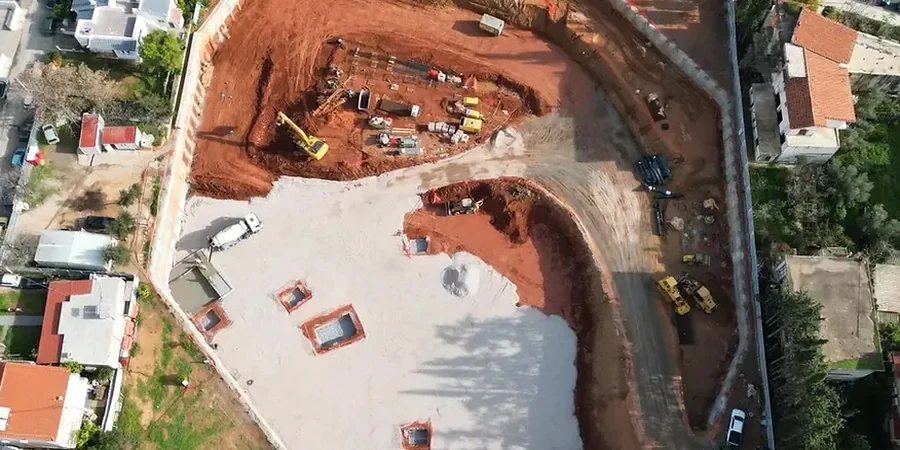
Site-specific factors
The Ontario Building Code and CSA A23.3 set clear expectations for deep excavation safety, but in Kitchener the risk profile is shaped by the interface between the upper aquifers and the lower confining units. A design that ignores the artesian pressure beneath the regional aquitard can result in a sudden base blowout during the final lift — we've seen the aftermath near Victoria Street where a sump pump couldn't keep up. The proximity of aging combined sewer infrastructure downtown adds another layer: vibration from sheet pile driving can disturb century-old brick conduits. Our design process runs sensitivity analyses for multiple groundwater scenarios, including a conservative winter high-stand that many firms overlook. We also evaluate the impact radius of dewatering on neighboring foundations, because in the Civic Centre area, buildings from the 1920s sit on shallow footings that respond badly to pore pressure drops.
Reference standards
National Building Code of Canada (NBCC 2020) — Section 4.2 on excavations and shoring, CSA A23.3-14 — Design of concrete structures, relevant for secant and diaphragm walls, ASTM D7181 — Consolidated drained triaxial compression test for soils, Ontario Regulation 332/12 (Building Code) for geotechnical site investigation requirements
Linked services
Shoring system design and analysis
We size soldier piles, secant walls, or diaphragm walls using PLAXIS 2D/3D with soil parameters calibrated from your site-specific borehole and CPT data. Designs include staged excavation sequences with predicted bending moments, shear envelopes, and deflection profiles.
Groundwater control and dewatering plan
Kitchener's perched water tables demand a tailored approach. We model drawdown radius, settlement impact on adjacent structures, and specify wellpoint or deep well systems with real-time monitoring triggers tied to pore pressure sensors.
Base stability and basal heave assessment
For cuts deeper than 6 meters in the Grand River corridor, we run Terzaghi and Bjerrum analyses to confirm the aquitard won't rupture. Where risk is high, we design jet grouting or deep soil mixing to reinforce the plug before excavation reaches final grade.
Construction-phase instrumentation and monitoring
We install inclinometer casings behind the wall, vibrating wire piezometers at multiple depths, and optical prisms on exposed structures. Our team sets alert thresholds and reviews weekly data so you can adjust the dig sequence before a problem becomes a claim.
Typical parameters
Quick answers
What does a deep excavation design cost for a typical Kitchener site?
For a downtown Kitchener project with moderate shoring depth and standard groundwater conditions, design fees generally range from CA$3,040 to CA$11,560 depending on the complexity of the soil profile, the number of shoring alternatives analyzed, and the extent of instrumentation planning required.
How do you handle the dense till and boulders during the geotechnical investigation?
The Halton Till in Kitchener can be extremely dense and often contains large clasts. We use hollow-stem auger drilling with heavy-duty tooling and where needed, switch to rotary coring to get through boulder zones. CPT refusal is common here, so we supplement with SPT and downhole shear wave velocity measurements to build a reliable stiffness profile.
Can you design an excavation adjacent to a heritage building without causing damage?
Yes, and this is a regular requirement in Kitchener's Civic Centre and Victoria Park neighborhoods. We model the excavation sequence with small-displacement shoring methods, pre-support the cut with compensation grouting if the soil is loose, and install real-time tilt and vibration monitoring on the adjacent structure so the contractor gets immediate feedback if wall movements approach the allowable limit.