In Kitchener, every foundation decision starts with what lies beneath the surface. The Ontario Building Code, referencing the NBCC, mandates a thorough understanding of subsoil conditions before any significant construction proceeds. Our soil mechanics study addresses this directly, applying laboratory testing and geotechnical analysis to the unique glacial till and outwash deposits that define the Waterloo Moraine. With the region's population surpassing 600,000 and driving constant redevelopment, knowing your soil's shear strength, compressibility, and permeability is not optional. A grain-size analysis in our accredited lab reveals the particle distribution that controls drainage and frost susceptibility, while Atterberg limits testing quantifies the plasticity of local silty clays, parameters that change drastically across a single Kitchener lot.
Kitchener's glacial geology doesn't read textbooks; it demands site-specific soil mechanics to prevent differential settlement and foundation distress.
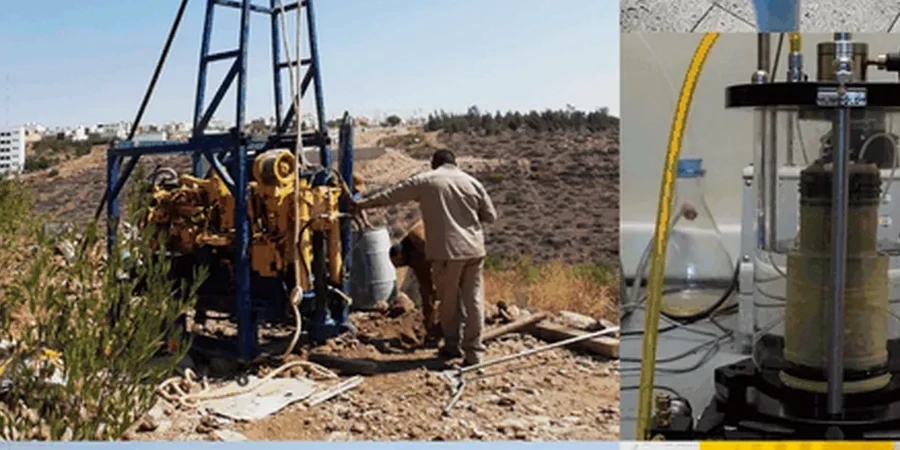
Scope of work
Site-specific factors
A common sight in Kitchener's older neighborhoods like Cedar Hill is the historic brick home with a new crack propagating from the window sill. More often than not, this traces back to differential movement in the desiccated clay crust, a condition easily missed without a proper soil mechanics study. Ignoring the lab phase after drilling is risky; we've seen projects where relying solely on field blow counts underestimated settlement by 30% because the soil's stress history was never quantified with a consolidation test. The Waterloo Moraine complex can hide soft pockets between dense till layers. A comprehensive study that measures shear strength and compressibility is the only way to calibrate a geotechnical model that prevents structural distress, keeps your project on schedule, and satisfies the strict Kitchener building permit requirements.
Reference standards
NBCC 2015 (National Building Code of Canada), CSA A23.3-14 (Design of Concrete Structures), ASTM D4767 (Triaxial Compression Test)
Linked services
Advanced Laboratory Testing
From consolidated-undrained triaxial tests to incremental consolidation, we quantify strength and settlement parameters on undisturbed Shelby tube samples extracted from your Kitchener site.
Foundation Design Parameter Reports
We deliver a factual and interpretive report with bearing capacity, anticipated settlement, and lateral earth pressure coefficients tailored to Ontario Building Code requirements.
Typical parameters
Quick answers
What does a soil mechanics study cost for a single-family home in Kitchener?
For a typical residential lot in Kitchener, a soil mechanics study including a borehole, lab testing, and an engineering report generally ranges from CA$4,650 to CA$7,470. The final investment depends on the depth of exploration, number of samples tested, and the complexity of the lab program required to satisfy the building permit.
Why is a triaxial shear test needed instead of just using SPT blow counts?
SPT data is empirical and influenced by operator technique and equipment. A triaxial shear test on an undisturbed sample measures the effective stress parameters (friction angle and cohesion) directly, providing a much more reliable basis for bearing capacity calculations, especially in Kitchener's sensitive silty soils.
How long does it take to get the lab results and final report?
We typically schedule drilling within a week of authorization. Consolidation tests require time for incremental loading, so full lab results and the interpretive soil mechanics report are usually delivered within 10 to 15 business days after sampling.
Does your study cover the requirements for a Kitchener building permit?
Yes. Our reports are stamped by a licensed Professional Engineer in Ontario and comply with the geotechnical requirements of the Ontario Building Code. They carry out all necessary design parameters for foundation review and approval by City of Kitchener building officials.