You see the excavator bucket break ground in a Kitchener subdivision and the soil profile tells a story instantly—alternating bands of silty clay and dense till that have been compacted by ten thousand years of glacial history. That stratigraphy demands more than a textbook bearing capacity equation. In our expertise working across Waterloo Region, a shallow foundation design that performs for fifty years starts with understanding exactly where the groundwater table sits seasonally and how the Wentworth Till reacts when loaded. When we mobilize our drilling equipment for a site investigation off Homer Watson Boulevard or near the Grand River, we’re looking for those subtle transitions that NBCC 2015 requires us to characterize before a single footing dimension gets calculated. The spt-drilling data we gather in the first forty-eight hours shapes every assumption in the load-settlement curve.
A footing designed without seasonal groundwater data in Kitchener is a settlement claim waiting to happen.
Scope of work
Site-specific factors
Kitchener sits on a glacial legacy that doesn’t announce its weaknesses: pockets of soft, normally consolidated silt buried beneath a stiff desiccated crust are common across the city’s west end, and they’re easy to miss with a shallow investigation. A 2021 geotechnical review of low-rise residential claims in the region pointed to undetected compressible layers as the primary trigger for angular distortion complaints within the first three years. When the footing loads exceed the preconsolidation pressure of those silts, the settlement curve steepens quickly. We’ve seen cases where a strip footing designed for 150 kPa on the crust performed fine through one wet season, then punched through after a record rainfall raised the water table to within a metre of the underside of footing. That’s why our shallow foundation design protocol mandates at least one borehole or test pit extending to four metres below the proposed bearing elevation, with Atterberg limits run on every distinct stratum we encounter.
Reference standards
NBCC 2015, Part 4, Division B (Structural Design), CSA A23.3-14: Design of Concrete Structures, ASTM D1194 / D1195 (Plate Load Test, referenced in site investigations), Canadian Foundation Engineering Manual, 4th Edition (CFEM)
Linked services
Bearing Capacity and Settlement Analysis
We compute allowable bearing pressures using limit equilibrium methods (Terzaghi, Meyerhof, Vesic) calibrated against your site-specific SPT N-values and lab consolidation data. The report includes immediate and consolidation settlement predictions under your column and wall loads, with sensitivity to seasonal saturation changes.
Footing Design and Subgrade Preparation Specs
Dimensioned drawings for isolated, strip, and combined footings with reinforcement detailing per CSA A23.3. We carry out written subgrade compaction criteria, granular fill gradation envelopes, and frost protection details dimensioned for Kitchener’s 1.2-metre frost line.
Typical parameters
Quick answers
What does a shallow foundation design package cost in Kitchener?
For a typical single-family residential or small commercial project in Kitchener, the shallow foundation design—including bearing capacity analysis, settlement calculations, and dimensioned footing drawings—runs between CA$2,430 and CA$4,210. The range depends on the number of footing types, whether we need consolidation testing on silts encountered in the borehole, and the structural loads involved. We carry out a fixed-fee proposal after reviewing the geotechnical investigation report.
How deep do footings need to be in Kitchener to avoid frost heave?
NBCC 2015 requires foundation depths to extend at least 1.2 metres below finished grade in the Kitchener-Waterloo area, based on the regional frost penetration data. On poorly drained silty soils we often recommend 1.5 metres with a granular drainage layer beneath the footing to interrupt capillary rise and reduce ice lens formation at the bearing surface.
Do I need a geotechnical investigation before you can design the footings?
Yes, and it’s non-negotiable. We need SPT N-values or CPT tip resistance from at least one borehole or test pit that extends a minimum of four metres below the proposed bearing elevation. Without that stratigraphic log and lab index testing, we cannot defensibly calculate allowable bearing pressure or identify the compressible silt seams that Kitchener’s glacial geology is known for.
What type of concrete and reinforcement do you specify for footings in this region?
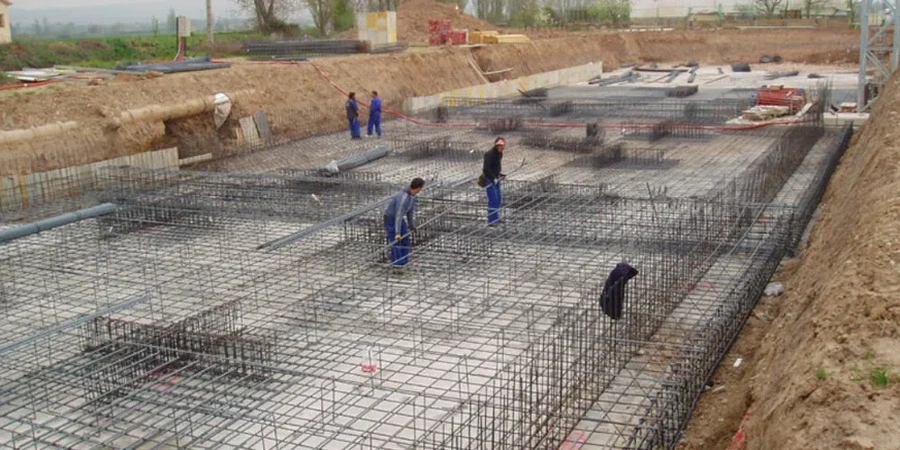
We specify 25 MPa minimum compressive strength concrete with air entrainment for exterior footings exposed to freeze-thaw cycles, per CSA A23.1. Reinforcement follows CSA A23.3 detailing requirements, typically 15M or 20M bars at 200–300 mm spacing, with yield strength of 400 MPa. Exposure class C-1 or C-2 is assigned based on sulphate testing of the site soils.