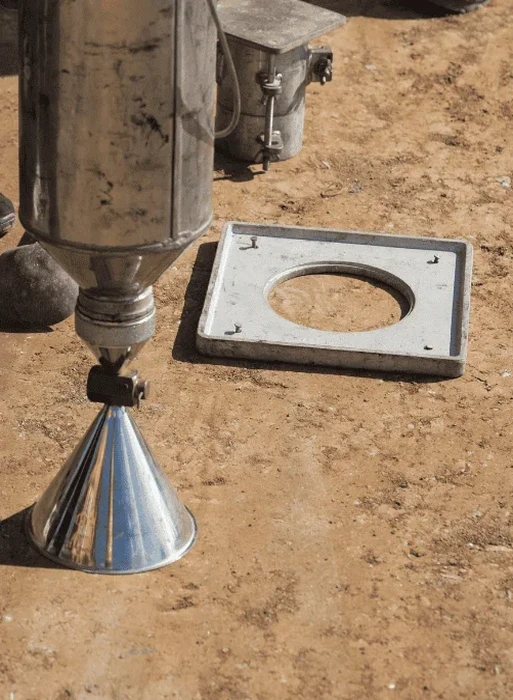
Kitchener sits squarely on the Waterloo Moraine, a complex deposit of sandy silt till, glaciofluvial outwash, and occasional clay lenses left behind by the last ice age. That geology creates highly variable compaction behavior — what passes a proof roll in one corner of a site often fails twenty meters away. The sand cone method remains the most direct way to verify that lifts of backfill, engineered fill, or granular subbase actually meet the specified density before structural loads or pavement are placed on top. We run these tests under CSA A23.3 and NBCC guidelines, with a calibrated Ottawa sand that holds its gradation across dozens of measurements. For deeper bearing verification before the fill goes in, we often pair density control with spt drilling to check in-situ resistance in the native moraine deposits, giving the geotechnical report a complete picture from undisturbed ground up to finished grade.
The sand cone gives you a physical hole and a direct mass-to-volume ratio — no calibration transfer, no source drift, no guessing about oversize correction.
Scope of work
Site-specific factors
Kitchener’s population has pushed past 270,000, and the pressure to open new subdivision phases and commercial pads before winter shutdown means compaction shortcuts are real. Inadequate density in a frost-susceptible silt on the moraine doesn’t announce itself until the spring thaw cycles break open the pavement or a foundation edge settles enough to crack drywall. A sand cone test costs a fraction of a single core-and-patch repair on a failed driveway approach, and it provides the documented proof that the compaction spec was met before the asphalt plant even fires up. On larger earthworks near the Grand River floodplain, where groundwater is within two meters of finished grade, verifying lift density becomes a stability issue — loose granular fill in a saturated condition loses effective stress and can trigger slope sloughing that stops grading for weeks.
Reference standards
NBCC Part 4 — Structural Design (compaction acceptance criteria), CSA A23.3 — Concrete Design (backfill and subgrade requirements), ASTM D1556 — Standard Test Method for Density of Soil in Place by the Sand-Cone Method, ASTM D698 / D1557 — Proctor compaction reference (Standard and Modified), OPSS 501 — Ontario Provincial compaction specifications for granulars
Linked services
Structural fill and backfill verification
Testing each lift of engineered fill beneath footings, slabs-on-grade, and retaining wall backfill zones. We match frequency to NBCC Part 4 tables and flag any lift below 95% Standard Proctor before the next lift is placed, keeping the compaction train moving without rework.
Pavement subgrade and granular base acceptance
Density control on subgrade under flexible and rigid pavement sections, plus granular A and B base courses. We coordinate with the grader operator to test immediately after rolling so results are available before the next truckload of asphalt or concrete arrives on site.
Typical parameters
Quick answers
What does a sand cone field density test cost for a typical Kitchener job?
For single-family residential or small commercial sites in Kitchener, a field density test using the sand cone method typically runs between CA$160 and CA$180 per point, which includes the technician on site, calibrated sand, Proctor correlation, and the signed PDF report. Larger earthworks projects with multiple lifts and a daily testing schedule may be structured under a weekly rate that brings the per-point cost down; we can carry out a fixed quote once we review the grading plan and lift schedule.
How many density tests does the NBCC require for a building pad in Kitchener?
NBCC Part 4 references a minimum frequency of one field density test per lift per 150 m² of structural fill area, with additional tests at utility trench backfill zones and around foundation perimeter drains. A typical 200 m² single-family pad with a 600 mm engineered fill pad placed in two 300 mm lifts would require at least two tests per lift, so four sand cone tests minimum before the footing forms go in. Heavier-loaded structures or variable soil conditions on the Waterloo Moraine often justify tighter spacing.
Can the sand cone test be used on coarse granulars and recycled concrete aggregate?
Yes, with the right procedure: the test hole diameter needs to be at least four times the maximum particle size, so for 40 mm minus recycled concrete aggregate we open a larger diameter hole and use a correspondingly larger sand volume. The physical excavation avoids the oversize correction problem that affects nuclear gauge readings on coarse material. We also take a sample from the excavated material for a grain size check when the gradation spec is tight, confirming whether the aggregate meets OPSS 501 limits.