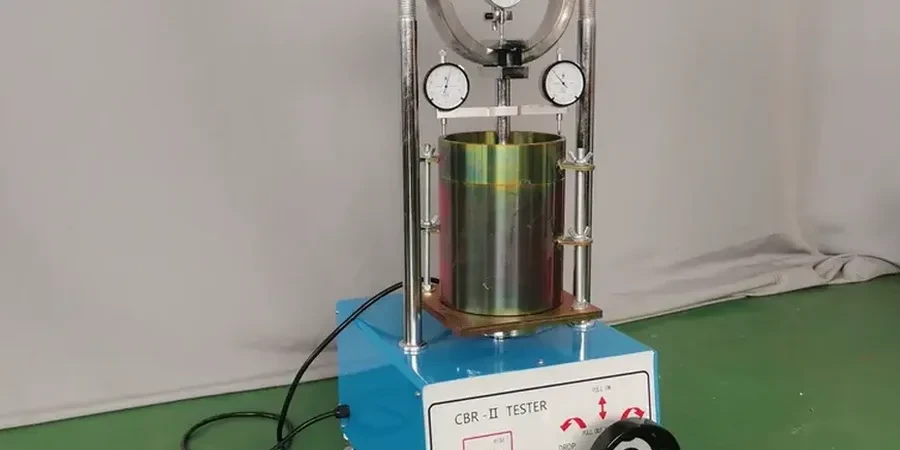
The compact loading frame on the lab floor applies force at a steady 1.27 mm per minute, the proving ring dial ticking upward as the piston pushes into the compacted soil specimen. That is the California Bearing Ratio test running in a Kitchener geotechnical lab, and it is the single most relied-upon index for pavement design across Waterloo Region. With Kitchener’s silty clay tills and occasional sandy lenses, subgrade strength can shift markedly within a single project site. A laboratory CBR test gives engineers the soaked strength value they need to size asphalt or concrete layers, forecast rutting potential, and avoid overbuilding the structural section. For road widenings along Fairway Road, industrial park expansions near the Conestoga Parkway, or subdivision streets in the Huron Village area, we run the test under controlled moisture and density conditions that replicate worst-case spring-thaw conditions. The result is a design CBR that holds up under Ontario’s freeze-thaw cycles and heavy truck traffic.
A soaked CBR value of 4 percent in Kitchener till demands a completely different pavement section than a CBR of 10 percent—and that difference can mean tens of thousands in material savings or costly premature failure.
Scope of work
Site-specific factors
Kitchener’s growth from an inland Mennonite settlement to a manufacturing hub and now a tech-driven city has spread pavement infrastructure across terrain that was never uniform to begin with. Older arterial roads laid down in the mid-20th century often sit on compacted fill of unknown composition, and when those roads are reconstructed today, the subgrade CBR can surprise even experienced contractors. A soaked CBR below 2.5 percent in silty clay till means the subgrade acts more like a sponge than a structural layer—pumping fines upward under repeated loading and triggering alligator cracking within a few seasons. The standard Kitchener solution is subgrade stabilization with cement or lime, followed by re-testing to confirm the treated CBR meets the structural design assumption. Skipping that verification step leaves the pavement vulnerable to spring load restrictions and maintenance costs that dwarf the original testing budget. For flexible pavement designs following the AASHTO 1993 method, a single percentage point shift in CBR changes the required granular base thickness by 25 to 40 millimetres—multiply that across a 2-kilometre road and the material cost swing is substantial.
Reference standards
ASTM D1883-21 Standard Test Method for California Bearing Ratio (CBR) of Laboratory-Compacted Soils, ASTM D1557-12 Standard Test Methods for Laboratory Compaction Characteristics of Soil Using Modified Effort, CSA A23.3 Design of Concrete Structures (referenced for rigid pavement sections), Ontario Provincial Standard Specification OPSS 1010 (material and testing requirements for granular base and subbase), MTO Laboratory Testing Manual LS-700 (CBR test procedure referenced in Ontario highway contracts)
Linked services
Subgrade CBR Evaluation for New Construction
We test bulk samples from test pits or boreholes across the proposed alignment, compacting and soaking specimens to determine the design CBR at subgrade elevation. Reports include moisture-density relationships and CBR at multiple compaction energies.
Treated Subgrade Verification Testing
After cement or lime stabilization, we re-run the CBR test on cured specimens to confirm the strength gain meets the specification. This is standard practice on Kitchener clay tills where untreated CBR falls below the municipal threshold.
Pavement Forensic Analysis
When existing pavements show premature distress, we extract subgrade samples and run soaked CBR tests to determine whether strength loss, poor compaction, or drainage failure is the root cause. The data supports rehabilitation design decisions.
Typical parameters
Quick answers
What does a laboratory CBR test cost for a Kitchener road project?
A single laboratory CBR test on a compacted soil specimen typically runs between CA$170 and CA$280, depending on whether the test is run at modified or standard Proctor effort and how many penetration points are required. A full pavement investigation with multiple specimens across a subdivision or arterial road will be higher, and the total cost depends on the number of test pits or boreholes sampled. Request a project-specific quote based on the linear metres of pavement and the variability of the subgrade.
Why does the CBR test require a 96-hour soaking period?
The four-day soak is designed to simulate the worst moisture condition the subgrade will expertise over the life of the pavement. In Kitchener, spring thaw saturates the upper subgrade as frozen ground releases water, and that is when the CBR is lowest. By testing after 96 hours of submersion, we capture a conservative strength value that ensures the pavement section remains adequate even during the critical spring period. The surcharge weights on the specimen mimic the confining pressure from the overlying pavement structure.
How does the laboratory CBR value translate into pavement thickness?
The soaked CBR feeds directly into structural design methods like the AASHTO 1993 flexible pavement equation or the Ontario MTO design charts. A lower CBR requires a thicker granular base and subbase to distribute wheel loads over a wider area at subgrade level. For example, a CBR of 4 percent might require 300 mm of granular base plus 150 mm of asphalt, while a CBR of 10 percent could reduce the granular thickness to 200 mm. The exact thicknesses depend on traffic loading, design life, and the structural number of the asphalt layers.
Can you run the CBR test on granular base material as well as subgrade soil?
Yes, the laboratory CBR test is routinely run on compacted specimens of Granular A and Granular B base and subbase materials to verify they meet Ontario specification minimums—typically 80 percent CBR for Granular A and 40 to 60 percent for Granular B. Testing the base course material confirms that the aggregate source provides the stiffness assumed in the pavement design, and it is particularly useful when the project uses a new quarry source or recycled concrete aggregate. More info.