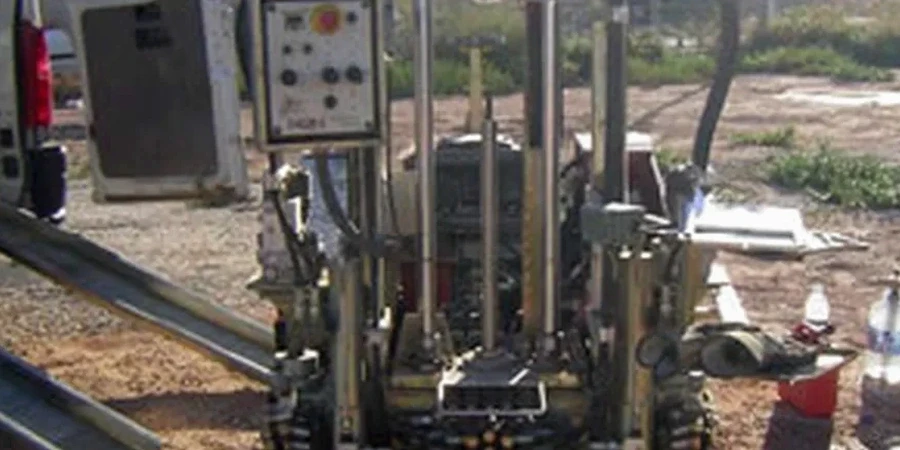
NBCC 2020 Division B sets the structural load path. But below the footing the soil is the first link in that chain. In Kitchener the ground rarely cooperates on the first attempt. The Port Stanley Till is dense, the outwash sands are loose, and the interface between them sits at unpredictable depths. A standard boring tells you what came up in the spoon. CPT tells you what is happening every 2 centimetres. We run the cone through silt, sand, and till while logging tip resistance, sleeve friction, and dynamic pore pressure. The continuous trace shows exactly where the weak seam sits. For Kitchener projects the CPT test becomes the baseline before we recommend anything else, because guessing the till depth here costs real money once the excavator hits refusal half a metre above the design elevation.
The cone sees what the spoon misses: a 0.3-metre silt seam at 5 metres that changes the entire foundation concept.
Scope of work
Site-specific factors
Kitchener's east side near the Grand River carries clean outwash sand with silt lenses that can liquefy under seismic loading. The west side sits on stiffer till but with erratic boulder content that can bend a cone rod if you push blind. On Chandler Drive we once hit a granite boulder at 6 metres that stopped the push dead. The friction ratio trace spiked for 20 centimetres and then the cone tilted past 12 degrees before the shear pin let go. In the downtown core the till is shallower but the fill layer above it is a mix of brick rubble, cinders, and old rail ballast from the Grand Trunk days. That fill reads like noise on the sleeve friction channel unless you filter the data with a moving window. Comparing two borings 30 metres apart is not enough here. The CPT gives you a continuous log that catches the transition from fill to till within a few centimetres, which matters when the column grid sits across that boundary.
Reference standards
ASTM D5778-20 – Standard Test Method for Electronic Friction Cone and Piezocone Penetration Testing of Soils, NBCC 2020 Division B – Structural design provisions referencing site-specific geotechnical investigation, CSA A23.3 – Design of concrete structures, foundation bearing requirements linked to in-situ testing, ASTM D6067-17 – Standard Practice for Using the Electronic Piezocone Penetrometer for Environmental Site Characterization, MTO Laboratory Testing Manual – Ontario reference for soil classification from CPT parameters
Linked services
Piezocone with dissipation tests
We stop the push at preselected depths and record pore pressure decay over time. The dissipation curve gives an in-situ estimate of the coefficient of consolidation, which directly informs the settlement timeline under the footing load.
Soil behavior type classification
Using the normalized SBT chart (Robertson 1990, updated 2016) we classify each 20 mm interval into one of nine soil behavior types. The output is a continuous soil-type log that does not rely on sample recovery.
CPT-to-shear-wave correlation
Where a seismic cone is deployed we measure shear wave velocity at 1-metre intervals. The Vs profile feeds directly into the NBCC site class determination and the liquefaction triggering analysis.
Typical parameters
Quick answers
How deep can a CPT push in Kitchener's Port Stanley Till?
Depth depends entirely on the till's consistency and boulder content. In the downtown area where the till is overconsolidated and relatively stone-free we routinely reach 20 to 25 metres. On the west side where boulder trains are common, refusal can occur anywhere from 8 to 15 metres. We monitor inclination continuously and stop the push if the cone tilts beyond 15 degrees to protect the rods.
What does a CPT test cost for a typical Kitchener residential or commercial site?
For a standard CPT sounding in the Kitchener-Waterloo area the cost ranges from CA$260 to CA$370 per push, depending on depth, access constraints, and whether piezocone or seismic cone modules are required. Mobilization is priced separately based on the number of sounding locations and site distance from our equipment yard.
Can a single CPT sounding replace a borehole for foundation design?
A CPT provides a continuous stratigraphic profile and direct measurements of tip resistance, sleeve friction, and pore pressure. But it does not recover a physical sample. For most Kitchener projects the best approach is to combine CPT soundings with at least one borehole at a key location so the lab can run index tests and confirm the CPT-based soil classification against actual grain-size and Atterberg limits.
How long does a CPT sounding take on a Kitchener site?
A single 20-metre push takes roughly 40 to 60 minutes of penetration time at the standard 20 mm/s rate. Adding four dissipation tests of 5 to 10 minutes each brings the total to about 90 minutes per location. Setup and breakdown add another 30 minutes. Most single-location jobs are completed within half a day, including data processing and a preliminary field log.