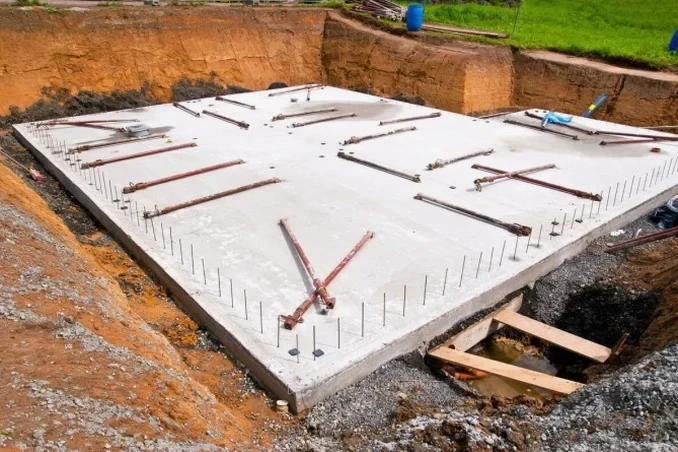
In Kitchener, many projects start on what looks like decent ground until you open the first test pit and find a pocket of loose silt right where the elevator core was supposed to sit. The glacial stratigraphy here—till over silty clay over limestone bedrock—doesn’t read like a textbook. When column loads get heavy or the footprint spans more than 300 m², isolated footings stop making sense. A raft foundation turns the whole footprint into one rigid plate, bridging soft spots that would otherwise cause differential settlement. Before we pour a single cubic meter, we run the numbers with real stiffness parameters from the site, not from a generic table. That often means pairing the raft design with a CPT test to map continuous stratigraphy, and when the water table sits at 2.8 m like it does across much of the east side, we layer in a MASW survey to confirm the shear-wave profile down to bedrock.
A raft foundation doesn’t eliminate settlement—it makes it uniform. On Kitchener’s glacial till, that distinction saves cracked partitions and misaligned door frames.
Scope of work
Site-specific factors
A 14-story residential tower on King Street East was designed with a 900 mm mat on the assumption of uniform dense till. During excavation, the contractor hit a 2.1 m deep pocket of organic silt under the southwest corner—old buried creek bed, not mapped on any surficial geology sheet. The original bearing pressure of 310 kPa was no longer viable on that corner without excessive differential settlement. The fix wasn’t piles; it was a local over-excavation, replacement with engineered fill compacted to 98% Standard Proctor, and a 200 mm increase in mat thickness over that quadrant. The delay was three weeks. That project taught half the contractors in the Region of Waterloo that you don’t design a mat from boreholes at the property line. You need investigation points inside the footprint, and you need the geotechnical engineer on site during excavation to verify the bearing surface matches the design assumptions. Without that, the concrete goes in blind.
Reference standards
NBCC 2015 (National Building Code of Canada, Part 4), CSA A23.3-14 (Design of Concrete Structures), Ontario Building Code (O. Reg. 332/12, as amended), ASTM D2487 (Soil Classification — lab index testing reference)
Linked services
Geotechnical investigation for mat foundations
CPT soundings and SPT boreholes on a grid that covers the entire slab footprint, groundwater monitoring, lab classification and consolidation testing, and a factual report with design parameters for the structural engineer.
Mat foundation design and settlement analysis
Finite-element modeling of the soil-structure interaction using the subgrade reaction approach, calculation of total and differential settlement, flexural and punching shear design of the mat, and reinforcement detailing under CSA A23.3.
Typical parameters
Quick answers
When does a raft foundation make more sense than isolated footings in Kitchener?
When the total footing area exceeds about 50% of the building footprint, or when column loads are heavy enough that isolated footings start overlapping. On Kitchener’s glacial till, we also recommend a mat when the soil profile varies significantly across the site—if one corner sits on dense till and another on softer silty clay, the mat bridges the transition and keeps settlement uniform.
What’s the typical cost for a raft foundation design in Kitchener?
The geotechnical investigation and design package for a mat foundation in Kitchener generally runs between CA$1,230 and CA$6,410, depending on the number of investigation points, the depth to bedrock, and whether consolidation testing is required. A quote comes after we see the architectural floor plan and the structural loads.
How deep do you need to investigate for a mat foundation in this area?
We investigate to a depth of at least twice the mat width below the bearing level, or until we hit competent bedrock, whichever is shallower. In Kitchener, where the limestone bedrock can be anywhere from 8 m to 25 m below grade depending on whether you’re on the Waterloo Moraine or closer to the Grand River valley, we typically go 15–20 m with CPT and confirm refusal with at least one deeper borehole.
Can a mat foundation be designed on fill or organic soils?
Not directly. Organic soils and uncontrolled fill have low stiffness and high creep potential, which means settlement continues long after construction. The standard approach in Kitchener is to over-excavate those materials, replace them with engineered granular fill compacted in lifts, and then place the mat on the prepared subgrade. The design then uses the properties of the fill and the underlying natural soil together.