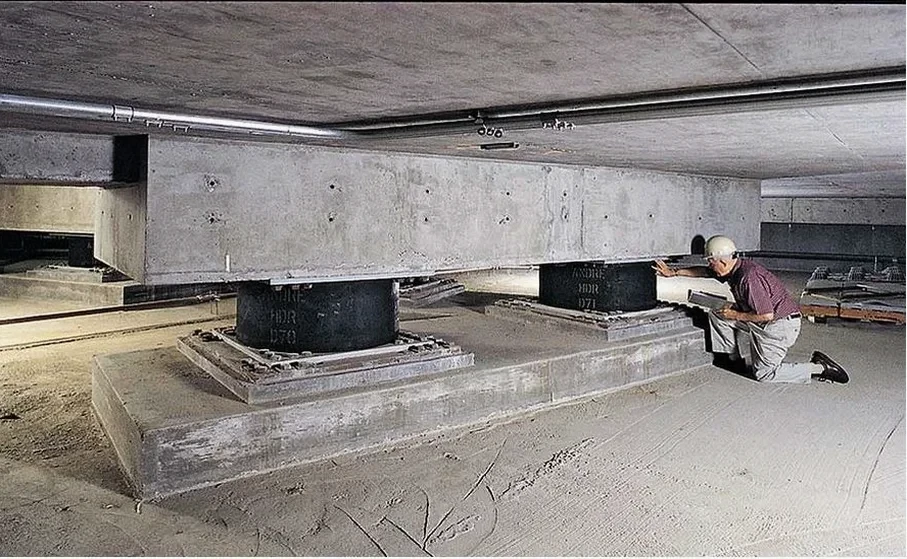
The National Building Code of Canada (NBCC 2020) places Kitchener within a moderate seismic hazard zone, but the real design challenge here isn't just ground shaking — it's the highly variable overburden. Glacial till, silt pockets, and the buried bedrock valleys that cut across Waterloo Region create sharp impedance contrasts that can amplify motion at specific periods. A base isolation system designed without accounting for these local site effects will underperform. Our approach starts with a site-specific seismic hazard assessment, correlating NBCC spectral accelerations with shear wave velocity profiles from the actual borehole data. We then model the isolation layer — typically high-damping rubber bearings or friction pendulum systems — to shift the structure's fundamental period well beyond the predominant site period. For Kitchener projects, this often means targeting 2.5 to 3.5 seconds for mid-rise buildings on the silty clay plains north of Highway 7, where the soft soils can produce site amplification factors above 1.8. The design must also satisfy Ontario Building Code requirements that reference CSA A23.3 for the reinforced concrete pedestals supporting the isolators, and ensure that the moat wall detailing accommodates the total maximum displacement under the 2% in 50-year event without pounding. When the geotechnical investigation reveals loose saturated sands, we combine the isolation design with a liquefaction assessment to verify that bearing capacity won't degrade under cyclic loading during the design earthquake.
In Kitchener's glacial geology, a well-designed base isolation system shifts the fundamental period far enough to avoid the amplified ground motion that soft soil sites produce — but only if the site response model uses real Vs profiles, not generic assumptions.
Scope of work
Site-specific factors
Compare the Victoria Park area, where the shallow limestone bedrock of the Guelph Formation lies within 8 metres of the surface, with the Fairway Road corridor where overburden thickness can exceed 30 metres of glaciolacustrine silt and clay. In Victoria Park, the stiff site conditions produce a relatively flat response spectrum with low amplification — a base isolation design there is straightforward, and the isolator displacement demands tend to be modest. In the Fairway area, the soft deep soils amplify long-period energy, and the same building design would see isolator displacements 40 to 60 percent larger, with higher mode effects in the superstructure that can concentrate drift in the upper floors. The Kitchener-specific risk is amplified by the fact that many commercial buildings in this city were constructed between 1960 and 1990, before modern ductility detailing was standard practice. Retrofitting these structures with base isolation requires a detailed nonlinear time-history analysis that captures the interaction between the existing lateral system and the new isolation layer. The biggest liability we've observed is insufficient geotechnical characterization: three boreholes on a half-hectare site won't capture the lateral variability of the glacial stratigraphy well enough to design a reliable isolation system. We recommend a minimum of one borehole per isolator cluster, with continuous shear wave velocity logging to bedrock or 30 metres, whichever comes first. The NBCC site classification must be confirmed by direct measurement, not correlation with SPT blow counts, because the silty clay tills in this region can produce misleading N-values when partially saturated.
Reference standards
NBCC 2020 (National Building Code of Canada, Seismic Provisions), CSA A23.3:19 (Design of Concrete Structures), CSA S6:19 (Canadian Highway Bridge Design Code, Seismic Isolation Section), ASCE/SEI 7-22 Chapter 17 (Seismic Isolation Requirements, referenced for building projects), ASTM D4015 (Resonant Column and Torsional Shear for Soil Dynamic Properties)
Linked services
Site-Specific Seismic Hazard and Site Response Analysis
We develop uniform hazard spectra and conditioned ground motion suites for Kitchener coordinates, then run 1D and 2D site response models using measured Vs profiles to generate floor spectra at the isolation plane.
Isolator System Design and Specification
Full design of high-damping rubber bearings, lead-rubber bearings, or friction pendulum systems including effective stiffness, damping, displacement capacity, and prototype testing protocols per CSA S6.
Nonlinear Time-History Structural Analysis
Three-dimensional models incorporating isolator hysteretic behavior, superstructure nonlinearity, and soil-structure interaction effects for both new buildings and seismic retrofit of existing Kitchener structures.
Peer Review and Construction Support
Independent technical review of isolation designs prepared by others, plus field support during isolator installation, testing, and commissioning to verify compliance with project specifications and NBCC requirements.
Typical parameters
Quick answers
What base isolation systems are most suitable for Kitchener's soil conditions?
The choice depends on the site-specific soil profile and the building's dynamic characteristics. On the stiff till sites common in west Kitchener, high-damping rubber bearings perform well and are cost-effective for low to mid-rise structures. For the deeper soft soil sites near the Grand River valley, friction pendulum systems offer advantages because their effective period is independent of the supported mass, which simplifies tuning when the soil amplification is strong in the 1-2 second range. For heavy structures on soft clay, we often evaluate lead-rubber bearings with larger lead cores to carry out the necessary energy dissipation per cycle. The final selection always follows a comparative study that considers the full life-cycle cost, including bearing replacement access and the thermal effects of southern Ontario winters on elastomer stiffness.
How much does a base isolation design for a Kitchener project cost?
The design cost for a base isolation system in Kitchener typically ranges from CA$5,820 to CA$11,680, depending on the building size, number of isolators, and the complexity of the site response analysis required. A simple rectangular building on a stiff till site with 12-15 isolators falls toward the lower end, while a geometrically irregular structure on deep soft soils requiring 3D nonlinear time-history analysis and multiple ground motion suites is at the upper end. This range covers the complete design package: site-specific hazard assessment, isolator specification, structural analysis, and preparation of sealed engineering documents for building permit submission.
Does NBCC 2020 require base isolation for buildings in Kitchener?
No, NBCC 2020 does not mandate base isolation for any specific building category in Kitchener. The code permits base isolation as one of several seismic force-resisting system options. However, for post-disaster buildings, hospitals, and other essential facilities, the NBCC imposes stricter drift limits and higher importance factors, which often make base isolation the most practical solution. For conventional structures, isolation becomes attractive when the owner wants to protect non-structural components, maintain occupancy immediately after the design earthquake, or reduce insurance premiums. The decision is typically driven by a performance-based design analysis that compares the life-cycle cost of a fixed-base versus isolated solution for the specific Kitchener site conditions.
What geotechnical data is required before starting a base isolation design?
We need a comprehensive geotechnical investigation that goes well beyond standard bearing capacity data. The minimum requirements include: shear wave velocity (Vs) profiles measured to at least 30 metres depth or bedrock, with continuous sampling through the soft soils; Atterberg limits and undrained shear strength for cohesive layers to assess cyclic degradation potential; standard penetration test (SPT) blow counts and grain size distributions for liquefaction screening in any sandy strata; and groundwater level monitoring through at least one seasonal cycle. For sites within the Grand River valley corridor, we also recommend resonant column or torsional shear testing on undisturbed samples to measure the modulus reduction and damping curves of the local silty clay, because these dynamic properties directly affect the site amplification that the isolation system must accommodate.