Kitchener sits approximately 330 meters above sea level, straddling the Waterloo Moraine — a geological feature that shapes every excavation and foundation in the region. The Standard Penetration Test remains the workhorse for evaluating these complex glacial deposits, from dense till to loose outwash sands. In our expertise, the variability across a single Kitchener lot can be significant, with N-values shifting dramatically over just a few meters depth. This test, performed in accordance with ASTM D1586, provides the consistent, repeatable blow counts that structural engineers rely on to design safe footings and deep foundations. For projects near the Grand River or on former agricultural land, we often supplement the Standard Penetration Test with a CPT test in Kitchener to resolve thin strata that the split-spoon sampler might miss in transitional zones.
A Standard Penetration Test in Kitchener must account for the Waterloo Moraine's stony till — cobble refusal isn't always bedrock, and misreading it can double your foundation costs.
Scope of work
Site-specific factors
The difference in Standard Penetration Test outcomes between a site near Victoria Park and one in the Bridgeport area underscores Kitchener's subsurface variability. The park area sits on thicker sand and gravel deposits with a shallow water table, often yielding N-values that suggest loose to compact conditions. Bridgeport, closer to the Grand River, can exhibit softer alluvial silts where Standard Penetration Test results drop below 5 blows per foot, triggering a need for deeper investigation. The biggest risk we see is designing foundations for a multi-unit residential building based on a single Standard Penetration Test boring that hit a cobble-strewn layer in the till and assumed refusal on rock. If you don't drill past that obstruction, the design could rely on an assumed bearing capacity that doesn't exist, leading to differential settlement. We always recommend at least two Standard Penetration Test locations for any Kitchener project over 500 square meters to capture the lateral variability of the moraine deposits.
Watch the video
Reference standards
ASTM D1586 – Standard Test Method for Standard Penetration Test (SPT) and Split-Barrel Sampling of Soils, CSA A23.3 – Design of Concrete Structures (reference for foundation requirements), Ontario Building Code (OBC) 2012, Part 4 – Structural Design (geotechnical considerations), NBCC 2015 – National Building Code of Canada, Section 4.2 (foundation design references)
Linked services
SPT Drilling and Sampling
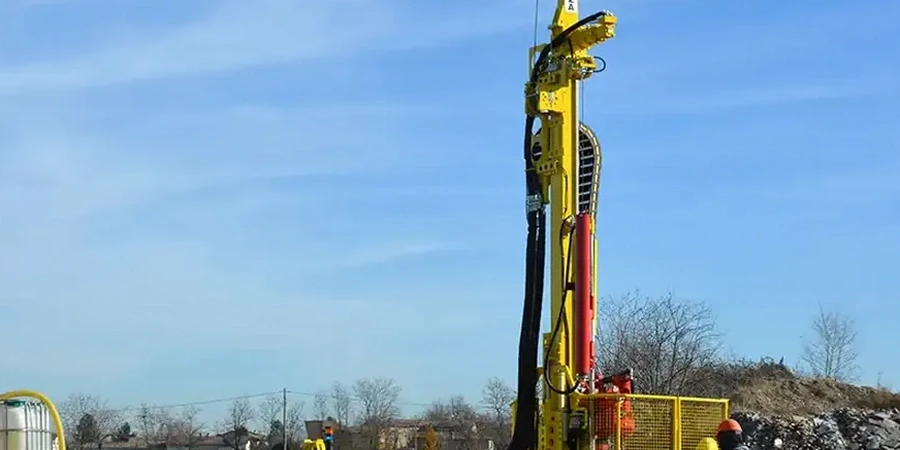
Our truck-mounted and track-mounted drill rigs access tight Kitchener lots to perform Standard Penetration Tests at regular depth intervals. Each sample is logged using the Unified Soil Classification System, with immediate field identification of till matrix composition, silt seams, and groundwater strikes.
SPT Data Interpretation and Foundation Recommendations
Beyond raw N-values, we carry out energy-corrected N60 profiles and correlate Standard Penetration Test results with undrained shear strength and relative density. For Kitchener's layered tills, this means differentiating between lodgement till and ablation till, and assigning appropriate bearing capacities for shallow foundations or pile design.
Typical parameters
Quick answers
How much does a Standard Penetration Test cost in Kitchener?
For a single Standard Penetration Test boring in Kitchener, you can expect to invest between CA$700 and CA$920, depending on site access, drilling depth, and the number of SPT samples required. This typically includes our drill crew mobilization, the calibrated hammer system, field logging, and a summary report with N-values and soil descriptions. Deeper exploration programs or sites requiring multiple boreholes will scale accordingly, and we carry out a detailed proposal after reviewing your project plans.
How deep can you drill for an SPT in Kitchener's glacial soils?
With our hollow-stem auger rigs, we routinely reach depths of 15 to 30 meters in Kitchener's glacial deposits. The actual depth limit depends on whether we encounter the dense, stony Port Stanley Till — which can slow penetration significantly — or cobble fields that may require switching to rock coring equipment. For most mid-rise residential and commercial projects in the city, 20 meters is sufficient to characterize the overburden and confirm the top of the bedrock surface.
What does the N-value from an SPT actually tell my structural engineer?
The N-value — the number of hammer blows to drive the sampler the final 12 inches — directly correlates with the soil's relative density in sands and its consistency in clays. In Kitchener, an N-value of 4 or less in a silt layer near the Grand River tells your engineer to expect soft, compressible ground that likely needs ground improvement or deep foundations. An N-value greater than 30 in the dense basal till indicates a very stiff bearing stratum capable of supporting spread footings for most low- to mid-rise structures. We apply the N60 energy correction to standardize these values, removing the variability introduced by different hammer systems.