Downtown Kitchener near King Street and the Innovation District sits on dense Halton Till — competent but riddled with silt lenses that complicate bond length. Cross over to the Grand River flats near Bingemans and you hit loose alluvial sand where passive wedge development demands a completely different approach. We see both extremes within a five-kilometer radius. That reality means a single anchor design philosophy fails here. In Kitchener, the choice between active and passive restraint depends on whether you are bracing a soldier pile wall in till or stabilizing a sheet pile bulkhead in saturated sand. We tie every strand to the deep excavation monitoring data we collect during construction, verifying load transfer in real time.
An anchor is only as reliable as the ground it bonds to — in Kitchener's interlobate moraine, that means verifying bond stress with on-site pullout tests before committing to production drilling.
Scope of work
Site-specific factors
The Halton Till across Kitchener contains isolated sand lenses under artesian pressure. We have drilled anchors where the bond zone intersected a pressurized lens and grout loss exceeded 40% before the seam sealed. If undetected, that condition produces an anchor with partial bond capacity that passes the lift-off test but creeps under sustained load. Corrosion is another long-term threat — the regional groundwater has moderate sulfate content, and de-icing salts migrate through fractured till near roadway retaining walls. We specify double corrosion protection for all permanent anchors in Kitchener and electrically isolate the tendon from the steel reinforcement of the supported structure. Anchor head maintenance access is designed into the wall detail; we have seen too many projects where the anchor head is buried behind a sidewalk pour and cannot be re-stressed.
Reference standards
NBCC 2020 (National Building Code of Canada), CSA A23.3:2019 — Design of Concrete Structures (Annex D: Anchorage), PTI DC35.1-14 — Recommendations for Prestressed Rock and Soil Anchors, ASTM A416/A416M — Low-Relaxation Seven-Wire Steel Strand, OPSS.MUNI 909 — Ground Anchors (Ontario Provincial Standard)
Linked services
Active Anchor Design
Prestressed strand anchors for soldier pile and diaphragm walls in dense till, with lock-off procedures that compensate for thermal relaxation during winter construction.
Passive Anchor Systems
Non-prestressed bar anchors for shallow retaining structures where controlled deformation is acceptable, verified through wedge stability analysis in granular overburden.
On-Site Suitability Testing
Pullout tests on sacrificial anchors to confirm ultimate bond stress before production drilling, critical in Kitchener's variable interlobate moraine deposits.
Lift-Off and Proof Testing
Hydraulic jack testing to 133% of design load with digital load cell logging, providing certified reports that meet Ontario municipal submission requirements.
Typical parameters
Quick answers
What is the difference between active and passive ground anchors?
Active anchors are prestressed after grouting — we apply a lock-off load that immediately restrains the structure and limits movement. Passive anchors are not prestressed; they develop resistance only when the structure deforms enough to mobilize the bond stress. In Kitchener, we typically specify active anchors for deep excavations adjacent to existing buildings where millimetre-level movement matters, and passive anchors for cut slopes or temporary shoring where some displacement is tolerable.
How deep do anchors need to go in Kitchener's glacial till?
Bond length, not total depth, controls capacity. In the Halton Till that underlies much of Kitchener, we typically achieve bond stresses between 150 and 250 kPa. A 6-metre bonded length in competent till can develop 400 to 600 kN per anchor. The unbonded length must extend beyond the critical failure surface, which we model using Kranz or Broms methods depending on the wall configuration.
What does anchor design and installation cost in Kitchener?
For a typical permanent active anchor in Kitchener soils, budget between CA$1.340 and CA$5.590 per anchor installed and tested, depending on depth, bond length, corrosion protection class, and access constraints. Temporary anchors fall on the lower end; double-corrosion-protected permanent anchors with full documentation run higher. This includes drilling, tendon supply, grouting, and proof testing.
How do you verify an anchor is working correctly after installation?
We perform a lift-off test using a calibrated hydraulic jack and digital load cell. The anchor is loaded to 133% of the design lock-off load while measuring displacement. For active anchors, we verify the locked-off load has not dropped below 95% of the specified value. Creep tests on a percentage of anchors confirm long-term performance — particularly important in Kitchener's silt-rich till where consolidation around the bond zone can cause load redistribution over time.
What corrosion protection is required for permanent anchors in Ontario?
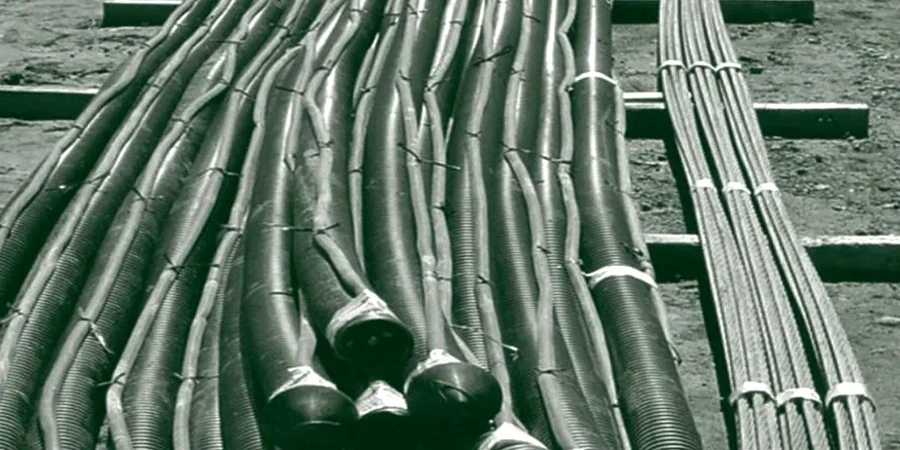
Per PTI recommendations and Ontario Provincial Standards, permanent ground anchors require double corrosion protection (Class I). This means the tendon is encapsulated in a corrugated plastic sheath filled with grout, with an outer sheath protecting the unbonded length. Kitchener's groundwater chemistry and winter de-icing salt exposure make DCP essential — we have investigated anchor failures elsewhere in Southern Ontario where single-layer protection corroded through in under 15 years.